What is a septic tank?
A septic tank is a passive (no electricity required) type of off-grid sewage treatment system.
A septic tank is usually either 1) a large concrete rectangular box or 2) a large plastic cylinder, buried underground not far from the property(s). On one end, the inlet is connected via piping to the property(s); on the other end, the outlet is connected to a ‘soakaway’ area, sometimes also called a ‘leach field’, in the surrounding land. All septic tanks require a soakaway area.
Sewage entering the septic tank naturally ‘settles’, with large solids sinking to the bottom to form a ‘sludge layer’. All septic tanks eventually require ‘de-sludging’ by a professional to remove this buildup at the bottom of the tank.
The middle layer is known as ‘effluent’ and is made up of relatively clear wastewater with small, suspended particles. Microorganisms including bacteria, archaea, and protozoa are responsible for breaking down this suspended matter, ‘treating’ the sewage as they do so. The treated effluent then exits the septic tank via the soakaway, where further treatment might occur with a different set of physical filters and microbial breakdowns.
The top layer is known as the ‘scum layer’ where other types of microorganisms digest what floats to the top of the tank.
The septic tank’s microorganism population can be damaged by boiling water, food scraps, grease, bleach, and harsh chemicals, which is why those are not recommended to put into your septic tank.
A well-functioning septic tank operates without oxygen, with a small ventilation pipe which removes the methane and hydrogen sulphide created by the microorganisms digesting the sewage. It is not safe to de-sludge or otherwise work inside a septic tank without professional training.
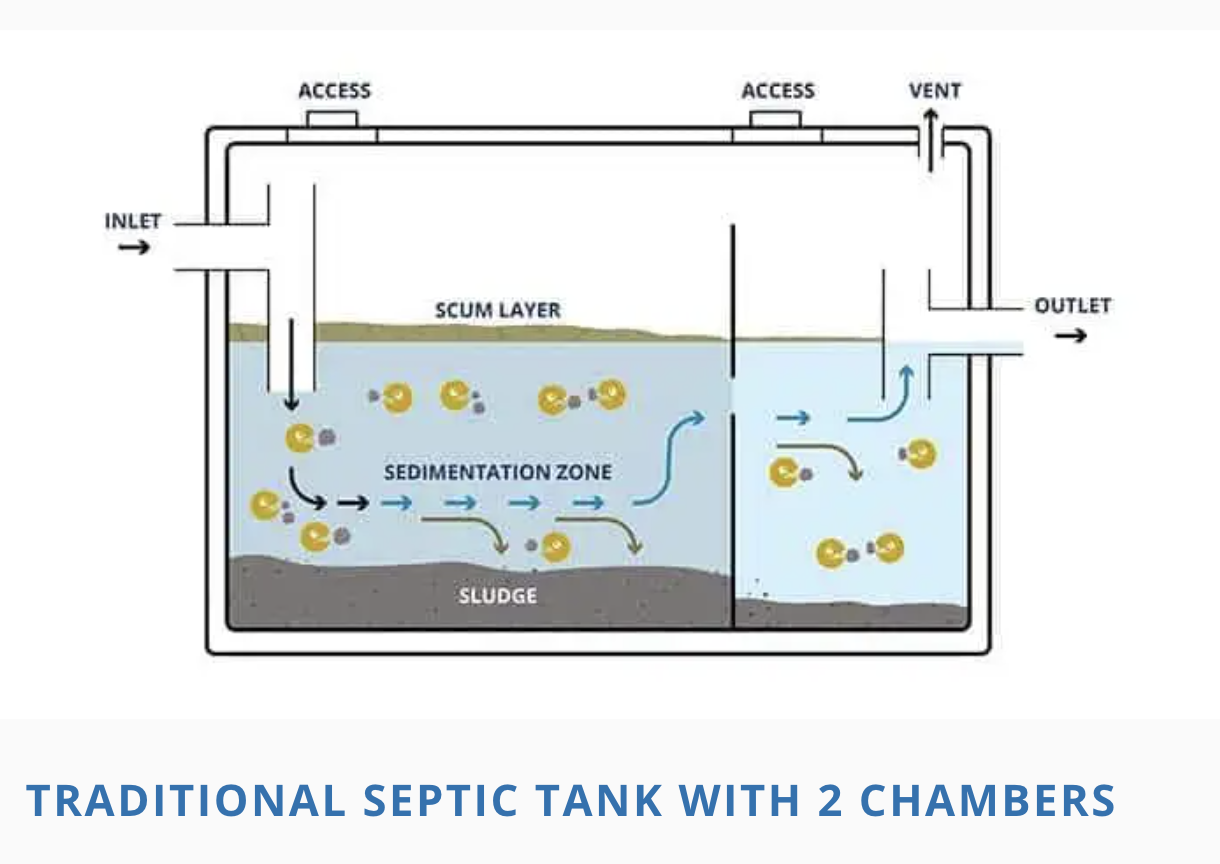
Diagram of a basic septic tank. Image credit: Muck Munchers
Remember - urine is not immediately ‘grey water.’
Urine is initially considered black water, just like other types of sewage. While it might be sterile inside your body, it is very high in nitrogen and can quickly become a source of pathogens after picking up bacteria inside a drain. For this reason, it should not go anywhere near your grey water tank.
However, once urine has passed through a sewage treatment system (e.g. after traveling through a septic tank or compost toilet) it is often referred to as grey water.
What are the regulations?
A septic tank sewage system is only powered by gravity, so it must be on lower ground than the property it serves. The soakaway area, where the effluent is released, must be lower again, and have the correct type of ground conditions. This suitability is determined through a ‘percolation test’ performed by a professional septic tank service company. This webpage provides a good explanation about percolation testing: https://www.septictankservicesltd.com/services/percolation-testing-scotland/
According to the Building Standards Technical Handbook 2020: domestic, the minimum distances of a septic tank must be:
at least 5 metres from a property boundary
at least 5 metres from any dwelling
at least 10 metres (horizontally) from any watercourse, road, or railway
at least 50 metres from a drinking private water supply
The Handbook further advises about the minimum size and performance standards of a septic tank. It is generally recommended to over-size your septic tank, to avoid pricey upgrades if the household grows or if another property wishes to connect to the same septic tank.
SEPA requires that any new or existing septic tank must have an “authorisation to discharge”. If you are not sure whether your property is already authorised or not, you can search the “Find authorisation Information” page on the SEPA website. If you do not find your property there, or if you require a copy of the registration form, you should check directly with SEPA by submitting a form.
If you need to register your septic tank with SEPA, first you must find out if you are a “small sewage discharge” from 9 properties or less. If yes, you can apply to register online. There is a registration fee of £190.
If you are part of a larger treatments system (10 properties or more) or if you are in a “phosphate sensitive catchment”, you need to apply for a permit instead. See this page on the SEPA website for more information on what to do next.
Other wastewater treatment system options
Not a cesspit
In Scotland, it is illegal to discharge any wastewater without first treating it. For this reason, cesspits are illegal in Scotland (even if they are legal in England), because their function is to simply store the sewage, as opposed to properly treating it.
Add-Ons
Septic tanks are sometimes referred to as a ‘settlement system’, and you have the option of integrating additional elements. For instance, instead of releasing the effluent directly into the soakaway, you could add on a nature-based treatment system such as an artificial wetland, reed bed, or packaged filter.
Or you could add multiple compartments to increase the size of the settlement system, which would also increase the amount of time the microorganisms have to treat the wastewater.
Sewage Treatment Plants
If you have access to a consistent electricity supply, you could look into a ‘package treatment plant’, also called a ‘sewage treatment plant’, which utilise multiple chambers, pumps, motors, aerators, and/or internal moving parts to more efficiently process the wastewater. Here is a case study of a full sewage treatment plant being installed near Fintry: https://www.septictankservicesltd.com/blog/sewage-treatment-plant-case-study/
Drainage specialists Drainmaster Scotland, based in Perth, have prepared a helpful webpage explaining the difference between septic tanks and sewage treatment plants, and other things that might be helpful for a homeowner to know in advance: https://drainmasterscotland.com/how-to-install-a-septic-tank-and-sewage-treatment-plant/
Composting Toilets
Composting toilets (sometimes referred to as ‘dry’ or ‘waterless’ toilets) are growing in popularity as an eco-friendly alternative, with many models suitable for the Scottish climate.
Approved Document G of the UK Building Regulations state that composting toilets ‘may be used’. The onus is on the property owner to prove that a composting toilet would meet the functional requirements set forth in the Building Regulations. There are currently no recognised British or European standards for composting toilets.
This 2010 case study investigated 5 different types of compost toilets found in the Forth Valley and Loch Lomond region, including costs and the researchers’ questions to the owners: https://www.fvl.org.uk/files/6914/5933/6032/FVL_Study_Report_28.4.10.pdf
Practical aspects, including SEPA’s regulations for the discharge of liquid from a composting toilet system, is frequently discussed at Reforesting Scotland’s peer-to-peer facebook group: https://www.facebook.com/groups/118307858251185
Connecting to the Mains
If you wish to connect your property to the public sewer system, here is Scottish Water’s guide on how to connect to their network: https://www.scottishwater.co.uk/-/media/scottishwater/document-hub/business-and-developers/connecting-to-our-network/all-connections-information/31823sw_sh_guidancepack.pdf
There is no financial assistance available for this process. Scottish Water will complete a technical audit of your request and issue a price quote accordingly.
Issues with an existing septic tank
Please check out the Digital Hub’s Support page about any issues with an existing private wastewater system.