A brief overview
Water and wastewater policy in Scotland is the responsibility of the Scottish Parliament, rather than the Parliament of the United Kingdom. This means decisions about how water is supplied, treated, and managed are made within Scotland. However, the legal framework that supports these policies is complex, and includes Scots common law and statutes, as well as European Union-derived water environment rules.
Water and wastewater policy areas can be roughly separated into:
Water and wastewater services– drinking water supply, wastewater treatment and rainwater drainage
Water resources – rivers, lochs, reservoirs and groundwater.
Scottish Government’s 2023 Programme for Government promised a review of water industry policy, but there has been no mention of this in any Programmes for Government since.
Many academic experts have proposed that resolving the key challenges facing Scotland’s water sector could be better enabled by consolidating and redefining Scotland’s legal framework.
Water and Wastewater Services
The legislative framework for water and wastewater services in Scotland is built around two key pieces of primary legislation:
Sewerage (Scotland) Act 1968 set out the requirements for Local Authorities to ensure that sewage and surface water is effectively drained and treated. Note: those now apply to Scottish Water.
Water (Scotland) Act 1980 established the powers and duties of Water Authorities. Note: those now apply to Scottish Water.
Both Acts significantly pre-date the reconvening of the Scottish Parliament in 1999, although they have been heavily amended since introduction.
Both Acts also pre-date the creation of Scottish Water, which was established by the Water Industry (Scotland) Act 2002. Scottish Water is now the public corporation responsible for the provision of water and wastewater services in Scotland.
Water Resources
The management of water resources in Scotland is underpinned by the European Union Water Framework Directive (Directive 2000/60/EC). This directive provides a framework for the protection and management of all surface and groundwater bodies; the primary objective is to achieve “good” ecological and chemical status through the use of integrated river basin management planning, pollution control and ecosystem restoration.
In Scotland, this Directive is delivered through the Water Environment and Water Services (Scotland) Act 2003 and through an amendment to the earlier Sewerage (Scotland) Act 1968.
The introduction of the Water Resources (Scotland) Act 2013 meant that Scottish ministers received a legal duty to take ‘reasonable steps as they consider appropriate for the purpose of ensuring the development of the value of Scotland’s water resources’ and to do so ‘in ways designed to promote the sustainable use of the resources.’
However, Scottish Government confirmed in 2023 during their Water, Wastewater and Drainage Policy Consultation that there is currently ‘no legal requirement’ for the Scottish Government to plan how the nation’s water resources are managed.
Further reading about today’s water and wastewater legislative environment can be found at the following links:
A 4-part blog published on the Scottish Parliament Information Centre (SPICe): https://spice-spotlight.scot/2025/10/28/legislating-for-water-resilience-part-1-key-challenges-facing-scotlands-water-industry/
A research briefing, also published on SPICe, regarding Scotland’s water industry as of 2025: https://www.parliament.scot/chamber-and-committees/research-prepared-for-parliament/research-briefings/2025/10/28/sb-2552#dp56938
Ownership of water and water bodies
In Scotland, fresh water resources, such as rivers, streams, lochs and other water bodies, are generally treated as a communal resource which are not privately owned in their natural state.
However, the rights to use them are often linked to ownership of adjoining land, such as the beds and banks of rivers and lochs. Those rights are known as ‘riparian rights’ and are determined by the doctrine of common interest and by modern statutory rules.
Those rules include the public access rights to most inland water under the Land Reform (Scotland) Act 2003, and environmental controls under the Water Environment and Water Services (Scotland) Act 2003.
The human right to water in Scotland…
Under international law, the human right to water relates to the right to an adequate standard of living, as well as the rights to life, health and dignity. Water services must be accessible, affordable, and of good quality.
The United Kingdom has committed to comply with this through a number of international treaties, including:
the International Covenant on Economic, Social, and Cultural Rights
the Convention on the Elimination of All Forms of Discrimination against Women
In Scotland, the human right to water has not been incorporated into domestic law. Currently, there is no legal mechanism to uphold the human right to water in the Scottish courts. There are only statutory protections for those already connected to the public water supply.
Researchers and academics have made the case that the human right to water is not being met in Scotland for many private water supply users, due to the current regulatory and governance arrangements.
More information can be found at: https://spice-spotlight.scot/2025/10/28/legislating-for-water-resilience-part-4-should-there-be-a-human-right-to-water-in-scotland/
…and a Human Rights Bill for Scotland
In 2023, Scottish Government opened a consultation on proposals to a new Human Rights Bill for Scotland. This included the direct question, ‘Do you agree or disagree with our proposed approach to including safe and sufficient water as a substantive aspect of the right to a healthy environment?’
According to Scottish Government’s consultation analysis in early 2024, respondents ‘… largely agreed with the proposed approach to including a right to safe and sufficient water as a substantive aspect of the right to a healthy environment, albeit they urged the Scottish Government to also include adequate sanitation as part of safe and sufficient water in light of concerns regarding sewage pollution.’
Many responses had also asked for water to be a substantive aspect of the right to an adequate standard of living, in keeping with the United Nations Sustainable Development Goal #6 which states ‘access to safe water, sanitation, and hygiene is the most basic human need for health and wellbeing.’
In July 2025, the Scottish Government published a Summary Discussion Paper, alongside an Easy Read version, and reiterated their ambition to evolve the human rights legal framework in Scotland.
However, actually introducing a new Bill will depend on the outcome of the May 2026 elections.
Scottish Water
Scottish Water is Scotland’s publicly owned provider for water and wastewater services. Scottish Water is primarily funded through customer charges (making up 90% of funding, according to 2024 figures) and the rest via borrowing from the Scottish Government. Scottish Water is classified as a public corporation of a trading nature, where ‘any surplus generated is reinvested in the provision of services to our customers’ according to Scottish Water’s 2024-2025 Annual Report.
Scottish water is regulated by a number of agencies including the Drinking Water Quality Regulator (DWQR) and the Scottish Environment Protection Agency (SEPA).
Scottish Water is answerable to Scottish Parliament through Scottish ministers, and it must demonstrate it is working towards the Ministerial Objectives: The Scottish Water (Objectives: 2021 to 2027) Directions 2020. Some of those objectives include:
…Scottish Water must identify and provide new strategic capacity that will meet the demand of all new housing development and the domestic requirements of commercial and industrial development for the 2021-27 period.
…Scottish Water must work with the Scottish Government to support the Scottish Government’s objective of ensuring reliable and sustainable rural waste and water services.
…Scottish Water, in collaboration with other parties as appropriate, must adopt and encourage a catchment management approach to sustainable storm water management wherever practical, to reduce and prevent the impacts of sewer and surface water flooding, reduce pollution from sewer overflows, enable growth, increase resilience and create natural spaces for customers and communities to enjoy.
Scottish Water also plays a role in delivering the Scottish Government’s wider environmental and social agendas, including its globally renown Hydro Nation Strategy. Scottish Water’s own long-term desired outcomes are:
1) Scotland’s tap water remains a source of national pride and is valued as a precious resource.
2) The quality of our rivers and seas has improved, and our communities are protected from sewer flooding, through collaboration with others.
3) Scottish Water has played a key role in enabling Scotland’s sustainable economic and housing growth.
What are Scottish Water’s priorities?
Those are laid out in Scottish Water’s Long Term Strategy, published in 2025.
One of Scottish Water’s current priorities is to increase public awareness about reducing water usage. This is strongly featured across its advertising and campaigns year-round, including ‘Your Water Your Life’.
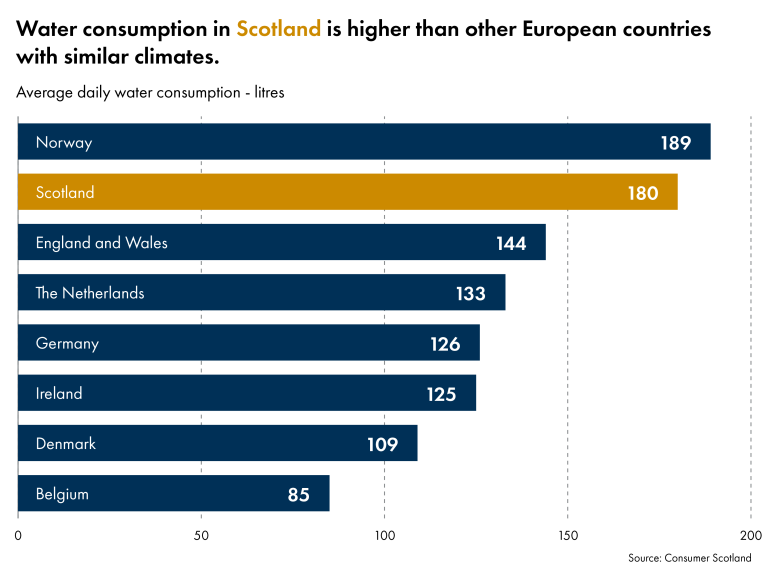
According to Consumer Scotland, water consumption in Scotland is higher than most European countries with similar climates, at an average daily consumption of 180 litres per person in 2023. This was second only to Norway (average 189 litres/person) and significantly higher than England and Wales (144 litres/person), Germany (126 litres/person), Denmark (109 litres/person) or Belgium (85 litres/person).
In 2023, Scottish Government acknowledged that unless adaptation steps are taken quickly, more than half of Scotland’s population will be at risk of water scarcity by 2050 during very dry periods.
Private water supplies and private wastewater systems
Scottish Water noted the following in its Long-Term Strategy, published in 2025.
We serve over 5 million customers and supply the length and breadth of the country: from large cities to remote islands. Some of our water treatment works serve a handful of customers, while others can treat enough water to supply much of the central belt.
And to make sure water is there for everyone, we have an extensive pipe network in place, with over 60,000 miles of water mains and sewer pipes. If we laid them end to end, they would wrap around the world twice.
As any private water supply or private wastewater system user knows, not ‘everyone’ in Scotland is actually being served by Scottish Water.
The number of households who cannot access Scottish Water’s water services is usually estimated as 3.5% of Scotland’s population, or around 190,000 people –– although experts including the Drinking Water Quality Regulator believe this is an under-estimation due to the lack of information about both the exact number of exempt private water supplies and the exact number of septic tanks.
Becoming a Scottish Water customer by connecting to the public water network is managed case-by-case, and by Scottish Water’s own cost estimates, will cost between £2,800 and £100,000 out of the property owner’s own pocket. Sewer connections follow a similar process, with feasibility depending on location and existing infrastructure capacity. No financial support is available for these connections, and no objectives exist from either Scottish Water or Scottish Government to address this.