What is a Borehole?
A borehole draws water from deep underground.
In parts of Scotland where the ground is made up of granite, sandstone, limestone, gravel or certain other rocks, rainfall finds its way underground through pores and fractures.
This underground environment is called an ‘aquifer’ and the water it holds is known as ‘groundwater’.
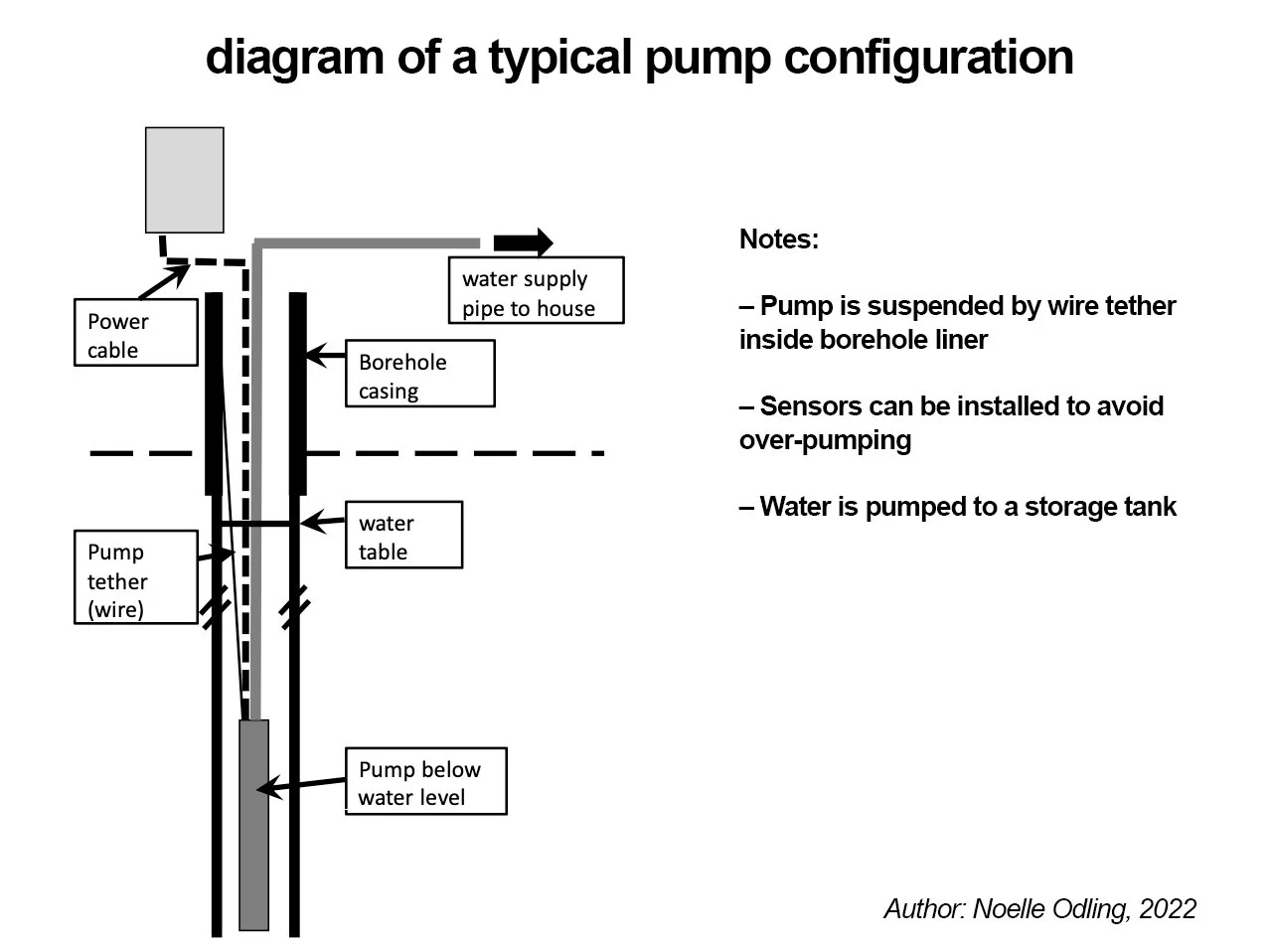
The groundwater is reached using specialist drilling equipment to create a narrow and deep borehole. A submersible pump then brings the water above ground for treatment and use.
Once constructed, a borehole is generally considered a reliable water supply. This is due to Scotland’s high levels of annual rainfall, which continually replenish the aquifers.
In Scotland, aquifers are found in a range of geological settings, including:
– Unconsolidated sediments (e.g. sands and gravels)
– Sedimentary rocks (e.g. sandstone)
– Fractured hard rocks (e.g. granite, shale, and metamorphic rocks)
In aquifers made up of unconsolidated sediments and sandstone, water is stored within pores between the mineral grains. In aquifers in hard rocks, water is held within open fracture systems.
Aquifers in unconsolidated sediments generally have high productivity. Aquifers in fractured hard rocks tend to be of lower productivity, but can still be useful for domestic water supplies in rural areas, particularly in the Highlands of Scotland.
How do I get a borehole?
Step 1: Geological Assessment
First, a hydrogeologist will review your site. They will assess the anticipated depth and yield of the aquifer. They will also inform you about potential contamination from surrounding land use, such as farming, forestry, or septic tanks. You must separately find out if there exist local restrictions against drilling, for instance if SEPA declares it is an ecologically sensitive area.
Step 2: Drilling
A specialist drilling rig and crew will arrive to dig your borehole. In Scotland, depths commonly range from 30 to 120 metres, and it’s not rare for it to need to be deeper. You will need to 1) notify the British Geological Survey if your borehole is over 15 metres deep and 2) submit records to the National Geoscience Data Centre.
Step 3: Casing & Sealing
Once the borehole has been created, the specialist crew will insert either steel or plastic casing down the shaft. They may also add a gravel pack to stabilise the borehole, then they will seal the upper section to prevent soil and other contaminants from falling in.
Step 4: Testing
A water sample from the borehole must be sent away for laboratory testing. The tests will check for bacteria, metals, minerals, pH, hardness, and ‘turbidity' (cloudiness). Other tests must also be conducted, including those checking the ‘recovery’ (speed of refilling to the natural water level) to ensure its supply is adequate for use.
Step 5: Pump installation
A submersible electric pump must be fitted inside the borehole, to efficiently transport water with strong, consistent pressure. The pump will need to be connected to a power source.
Step 6: Storage & Treatment
Depending on your water quality test results, necessary water treatment systems might include sediment filters, UV disinfection filters, iron or manganese removal, and/or pH correction. These systems would be installed inside your building near your storage tank, not at the location of the borehole.
NB this is an abridged summary of the process!
What are the costs of a borehole?
Costs vary greatly depending on location, depth, access, and treatment needs.
Rural and island places will likely see higher costs, due to logistical constraints. Scottish service providers will request further information before providing a quote.
However, here is some information from English providers:
In Suffolk the estimates are:
– Drilling and borehole construction: £8,000 to £20,000+
– Pump and internal equipment: £3,000 to £14,000+
– Storage and treatment: £1,000 to £13,000+
In the north of England, the estimate was, as of spring 2025:
– “Basic price” of a borehole: £20,000 to £35,000
– Storage and treatment: £5,000 to £10,00
The above do not include costs towards assessments or quality testing.
The only available grant scheme in Scotland is the Scottish Government private water supply grant (up to £800) which is administered through your local authority.
What Regulations Apply to Borehole Water Supplies in Scotland?
Most small domestic boreholes do not require a licence or planning permission. However, if you are abstracting (drawing up) larger volumes, it may require registration.
Either way, you must declare your borehole as a private water supply to your local authority’s Environmental Health department.
If your borehole supplies multiple properties and/or a business, such as a holiday let, rental property, or B&B, it is a ‘regulated’ private water supply and must be regularly tested by your local authority.
The owner of the borehole bears full responsibility to maintain the system and pay any repairs towards keeping it safe to use.
Where can I find out more?
Further resources and information on boreholes can be found below (opens in a new tab)
From SEPA (Scottish Environment Protection Agency), An Applicant’s Guide to Water Supply Boreholes
From Aquaswitch (a business water supplier in England), What is a Borehole Water Supply?
From FWR (Foundation for Water Research), A Householder’s Guide to Private Water Supplies
From Water Treatment Services (an independent UK water treatment and environmental services company), Guide to Drilling Boreholes – What You Need to Know
From UK Groundwater Forum, Groundwater Basics