ABSTRACTION POINTS 101
What is an Abstraction Point?
‘Abstraction’ means any temporary or permanent manmade activity to redirect any amount of water from any part of the natural environment. This includes the use of pumps, pipes, boreholes, wells, or even just placing a blue hose in a burn.
An ‘abstraction point’ is the official term, used across the UK, for the precise area where water is being drawn from.
SEPA’s own guidance states that excavations and other development have to operate outwith minimum buffer zones from an abstraction point, especially if it is for drinking water. While this guidance is not law, it might still be enforced by SEPA through fines, penalties, or prosecutions.
There exist both bad and good examples of abstraction points being protected by developers. For instance, SSEN was alleged to have broken the rules in this widely publicised incident which led to years of contamination of private water supplies. Meanwhile, as part of the environment impact assessment for dualling the A9, extensive consultations were conducted with private water supply users from Dalwhinnie to Crubenmore and from Crubenmore to Kincraig.
Where are the abstraction points near me?
It can be difficult to have a complete overview of all drinking water abstraction points in an area.
SEPA requires a registration for any abstraction points where the volume of water used exceeds 10 cubic metres per day. (That’s equivalent to 1,000 litres per day.) Anything smaller than this does not need to be declared to SEPA; therefore, the agency does not know where the smaller abstraction points are — i.e., most domestic setups.
Each local authority’s Environmental Health department has the responsibility to maintain a complete register of private drinking water supplies in their area, which would include many of those smaller abstraction points. However, gaps frequently exist for many reasons, including when property owners feel there is a lack of incentives for registering their private water supply.
Meanwhile, for public safety reasons under regulation 10(5)a, public authorities usually do not disclose the locations of public drinking water supply abstractions.
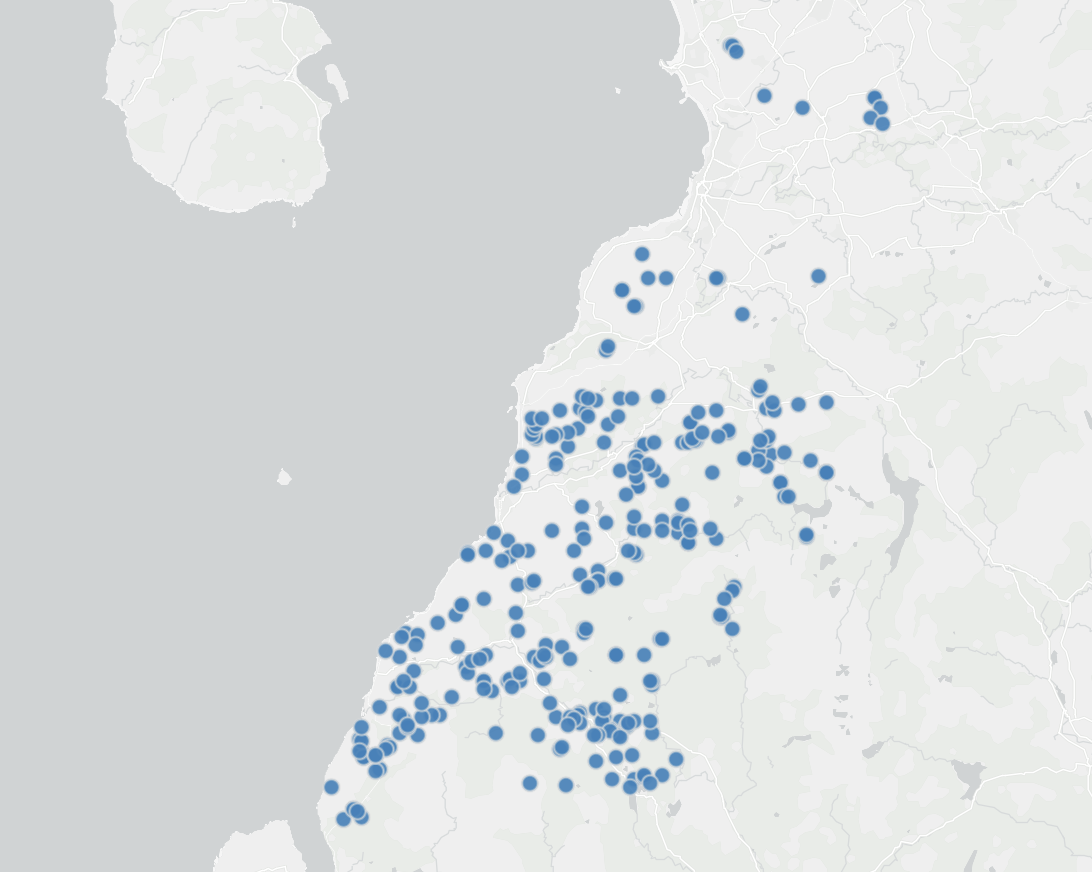
Above: South Ayrshire Council’s dataset of private water supply abstraction points known to authorities.
Contains OS data © Crown Copyright and database right 2026. Contains data from OS Zoomstack.
What are the rules for new abstractions in Scotland?
Less than 10m³ per day
If you will be abstracting less than 10 cubic metres (1,000 litres) of freshwater per day, you are simply expected to follow SEPA’s General Binding Rules. If SEPA finds out you are not complying with those General Binding Rules, it will be considered an offence. There are three General Binding Rules:
There must be a means of demonstrating that the abstraction is less than 10 m3 in any one day, such as a means of measuring the rate of the abstraction or a means of demonstrating that the maximum volume that could be abstracted cannot exceed 10 m3 in any one day,
Water leakage must be kept to a minimum by ensuring all pipe work, storage tanks and other equipment associated with the abstraction and use of the water are maintained in a state of good repair,
The activity must not be located within 50 metres of any existing well, spring or borehole used for a water supply.
Between than 10m³ and 50m³ per day
If you will be abstracting between 10 and 50 cubic metres of freshwater per day, this is known as a regulated activity and you must register with SEPA. The application fee is £190. The registration process includes filling out a 16-page form, titled R-WAT-C1, describing all aspects of your activity. SEPA will also ask if you or any other relevant person has any prior convictions, as only a ‘Fit and Proper Person’ is able to hold an authorisation.
Your application will not proceed if you cannot comply with the following ‘Standard Conditions’:
Standard conditions for Abstraction from inland waters from 10m³ to 50m³ per day
There must be a means of demonstrating the total volume of water abstracted daily.
The equipment used for the abstraction must be maintained so that it is fully functioning.
Any groundwater abstraction must not have a significant impact on any other groundwater abstraction.
Any surface water abstraction and equipment used for the abstraction must not cause harm to fish.
Over 50m³ per day
If the volume of abstraction will at any point exceed 50 cubic metres per day, you must register with SEPA. SEPA will ask for different application fees and annual activity fees depending on what the purpose is, e.g. irrigation, cooling, aquaculture, or mining. As part of the registration process you must complete the 40-page activity form P-WAT-WR1, including questions regarding any associated ‘impoundments’ (the storage of water).
Abstracting over 50 cubic metres for hydropower purposes requires an entirely different permit authorisation process with SEPA.
Other types of abstraction
Different authorisations are required if you are: abstracting from, and discharging back to, the same freshwater loch (due to concerns about contaminants, temperature etc); abstracting for the purpose of geothermal energy; and many other different activities. A full list of activities and accompanying regulations can be found on the SEPA page here: https://beta.sepa.scot/regulation/authorisations-and-compliance/easr-authorisations/water-activities/abstraction/surface-water-and-groundwater-abstraction/
A good summary about different abstraction licenses can be found on Scotland’s Farm Advisory Service: https://www.fas.scot/article/understanding-water-management-regulations-in-scotland/
If you have questions about abstraction, you can email SEPA directly at: waterpermitting@sepa.org.uk